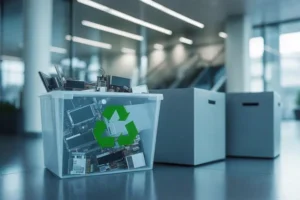
Walk into any mid-sized company’s storage room, and you’ll find the same scene. Stacks of old monitors. A pile of laptops with sticky notes on them. A dead server that somebody unplugged in 2019. A few hard drives in a drawer that nobody can quite remember the contents of.
This is the part of IT nobody puts on a roadmap. And it’s exactly why IT asset disposal services exist.
The honest version of the problem
Hardware doesn’t end its life cleanly. It limps along, gets pulled from production, sits somewhere “until we figure out what to do with it,” and then becomes someone’s problem when an audit comes around or a refresh ships and there’s nowhere to put the new gear. Most companies handle this badly. They throw equipment in the dumpster (often illegal, and a data breach waiting to happen). They donate it without wiping it properly (same risk, plus a feel-good story that could blow up later). Or they keep stacking it in a closet and pretend it’s not there.
A real IT asset disposal program — what the industry calls ITAD — fixes this by treating retired hardware as something that still has rules attached to it. Data on it. Materials in it. Sometimes, value is left in it.
Why “we’ll just toss it” doesn’t work anymore
Baytech Recovery, a Silicon Valley ITAD provider, puts it plainly: electronic hardware can no longer be sent to the shredder or put out for scrap. Environmental rules, data protection rules, EPA-level regulations — and consequences for getting any of them wrong.
The data piece bites hardest. Hard drives don’t go blank when you delete files. They don’t go blank when you reformat them. Anyone with basic recovery tools can pull data off a “wiped” drive that wasn’t wiped to a recognized standard. If that data included customer records or anything covered under HIPAA or GDPR, you’ve created a problem far more expensive than disposal would have been.
The environmental piece matters too. Enterprise buyers ask about sustainability during procurement. Investors ask. Employees ask.
What good IT asset disposal actually does
A few things, all at once:
It gets your data off the equipment for real. Certified data destruction means drives are wiped, shredded, or degaussed to standards that hold up under scrutiny, with paperwork to prove it.
It gets some of your money back. A lot of “old” equipment isn’t dead — it just doesn’t fit your current needs. Baytech’s in-house tech team refurbishes equipment to maximize ROI and remarkets what they can. Servers and networking gear often have surprising resale value. Done right, your disposal program can pay for itself.
It opens up tax benefits. Donating equipment through proper channels can qualify for tax write-offs. Recycling done correctly often does too.It keeps you compliant without you having to think about it. A certified provider works under R2v3, ISO 9001, ISO 14001, and ISO 45001. Somebody else has done the homework for the regulators, and you get to inherit it.
It actually clears the closet. Sounds dumb to mention, but a real ITAD pickup empties the storage rooms, gives you back the floor space, and hands you a documented inventory of what was hauled away.## The reuse-first approach
The industry has shifted toward reuse before recycling — treating disposal as the last option, not the first.
Part of this comes from the Open Compute Project, started by Facebook, Microsoft, and Google, which opened up hardware standards previously locked down by vendors. That created legitimate secondary markets for enterprise gear. Google’s data centers reportedly run a mix of new and refurbished equipment. If hyperscalers run on refurb, smaller operators can sell their old kit instead of scrapping it.
What to look for in a provider
Three things, mainly. Certifications that aren’t decorative — R2v3, ISO, e-Stewards mean something; vague “eco-friendly” claims don’t. On-site capability, because for anything beyond a few laptops, you want a team that handles pickup, decommissioning, and the right insurance. And clear reporting — inventory lists, chain of custody logs, certificates of destruction. Baytech runs an in-house ERP that tracks every client’s assets through the process, the kind of detail that separates a real ITAD shop from a guy with a truck.
IT asset disposal isn’t glamorous. Nobody gets promoted for closing out the storage closet. But it’s one of those quiet operational areas where doing it right protects your company from real risk, recovers real money, and makes your sustainability story actually true. Doing it wrong is a slow-burning liability nobody notices until it’s on fire.
If your retired hardware is sitting in a corner waiting for someone to deal with it, that someone should probably be a certified ITAD partner — not a Friday-afternoon volunteer with a moving cart.